Wireless Mic Frequency Coordination: The RF Plan Your Event Needs
A panel discussion with six lavalier mics and two handhelds sounds simple until minute forty, when one channel starts crackling and then drops out entirely, right as the moderator opens the floor to questions. Nobody spilled a drink on it and nobody unplugged anything. The mic died because two of the eight wireless systems were sitting on frequencies that created interference the moment both were keyed at once. That's an RF coordination failure, and it's one of the most preventable problems in event audio.
Wireless mics operate in a slice of UHF spectrum, mostly between 470 and 608 MHz after the FCC repack pushed broadcasters out of the old 700 MHz band. That range is shared with local TV stations, other production companies working nearby, and increasingly, unlicensed devices. Every wireless mic and IEM pack you run needs its own clean frequency, and in a crowded venue or a dense city block, clean frequencies are a finite resource. Grabbing eight mics off a shelf and turning them all on without a plan is asking for trouble.
The specific failure mode is intermodulation distortion. When two or more RF transmitters operate close together, they don't just occupy their assigned frequencies, they generate mathematical byproducts of those frequencies, and those byproducts can land directly on top of another mic's channel. The more transmitters you run simultaneously, the more intermodulation products you create, and the harder it gets to find open air. This is why adding
just one more handheld to an already-packed system can knock out a completely unrelated mic that was working fine five minutes earlier.
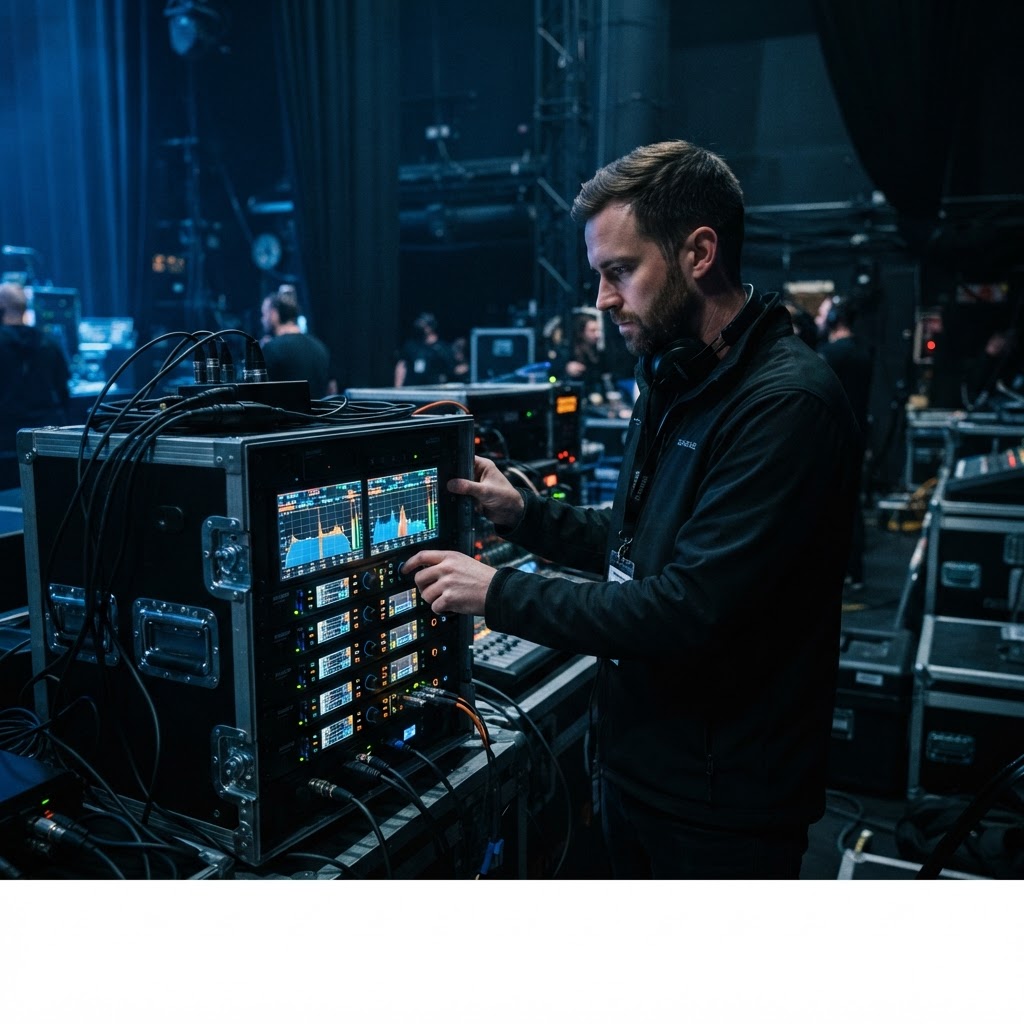
Professional audio teams don't guess at this. Software like Shure Wireless Workbench or Sennheiser's WSM scans the local RF environment, factors in every transmitter you plan to run, and calculates a coordinated frequency list that avoids intermod collisions before a single mic is powered on. For a small wedding ceremony with two mics, this takes minutes. For a corporate general session with a dozen presenter mics, IEMs for the band, and comms for stage managers, it's a real planning task that should happen before load-in, not during it.
How many clean channels you can realistically get depends on the venue and what else is happening around it. A quiet ballroom in a suburban hotel might offer forty or more usable frequencies. A downtown convention center hosting three trade shows simultaneously, sitting two blocks from a broadcast tower, might realistically support fifteen to twenty before things get tight. If your event needs more mics than the local spectrum can cleanly support, the answer isn't to squeeze them in and hope. It's to consolidate channels, use fewer open mics at once, or bring in a system that supports frequency-agile digital wireless with tighter channel spacing.
Backup planning matters as much as the coordination itself. Any presenter mic that absolutely cannot fail during a keynote or a vow exchange should have a wired backup on standby, not just a spare battery. Battery management is its own discipline: fresh cells or charged rechargeables in every pack at call time, and a labeled system for tracking which units have been used, because a mic that dies at 40% mid-ceremony is worse than one that never had a full charge to begin with. A single unassigned backup channel, coordinated along with everything else, gives your AV team a place to move a presenter instantly if a primary channel goes down.
Weddings have their own version of this problem, just smaller in scale. A typical high-end ceremony runs a lav on the officiant, sometimes a second lav on the groom, and a handheld for toasts at the reception. That's usually only three or four transmitters, but the venue matters just as much as the count. Hotel ballrooms saturated with guest Wi-Fi and other events happening the same weekend can still cause dropouts, especially with 2.4GHz digital wireless mics that share spectrum with every phone and laptop in the building. If your venue is Wi-Fi heavy, ask your audio team whether UHF analog or licensed digital wireless makes more sense than a consumer-grade 2.4GHz system.
For planners booking AV, the practical move is simple: ask for a written RF plan, not just a mic count. Confirm how many simultaneous wireless channels the system supports, whether a site RF scan will happen the day of the event, and what the backup protocol is if a channel fails live. If you're running a corporate event with broadcast, streaming, or comms systems layered on top of presenter mics, say so early, because those add transmitters to the same shared spectrum and change the whole coordination math. A five-minute conversation about frequency planning before the event is a lot cheaper than dead air during the CEO's keynote or silence during the vows.