Line Array vs. Point Source: Which Sound System Fits Your Room?
A planner asks for a line array because they saw one at a concert and it looked impressive. An AV vendor quotes point source because it's cheaper and faster to set up. Neither reason has anything to do with whether the system will actually sound good in the room being booked. The right choice comes down to room geometry, throw distance, and audience shape — not what looked cool on someone else's event.
Point source speakers radiate sound from a single point, spreading in a roughly conical pattern. A pair of full-range boxes on poles or a small flown pair can cover a room up to about 60-80 feet deep with even, predictable coverage, especially when the audience is seated in a fairly uniform rectangle. This is the right call for a 200-person corporate general session, a hotel ballroom keynote, or most private events and weddings where the room isn't absurdly long or narrow. Point source rigs are faster to deploy, require less rigging infrastructure, and cost less to run — all real advantages when the room doesn't demand more.
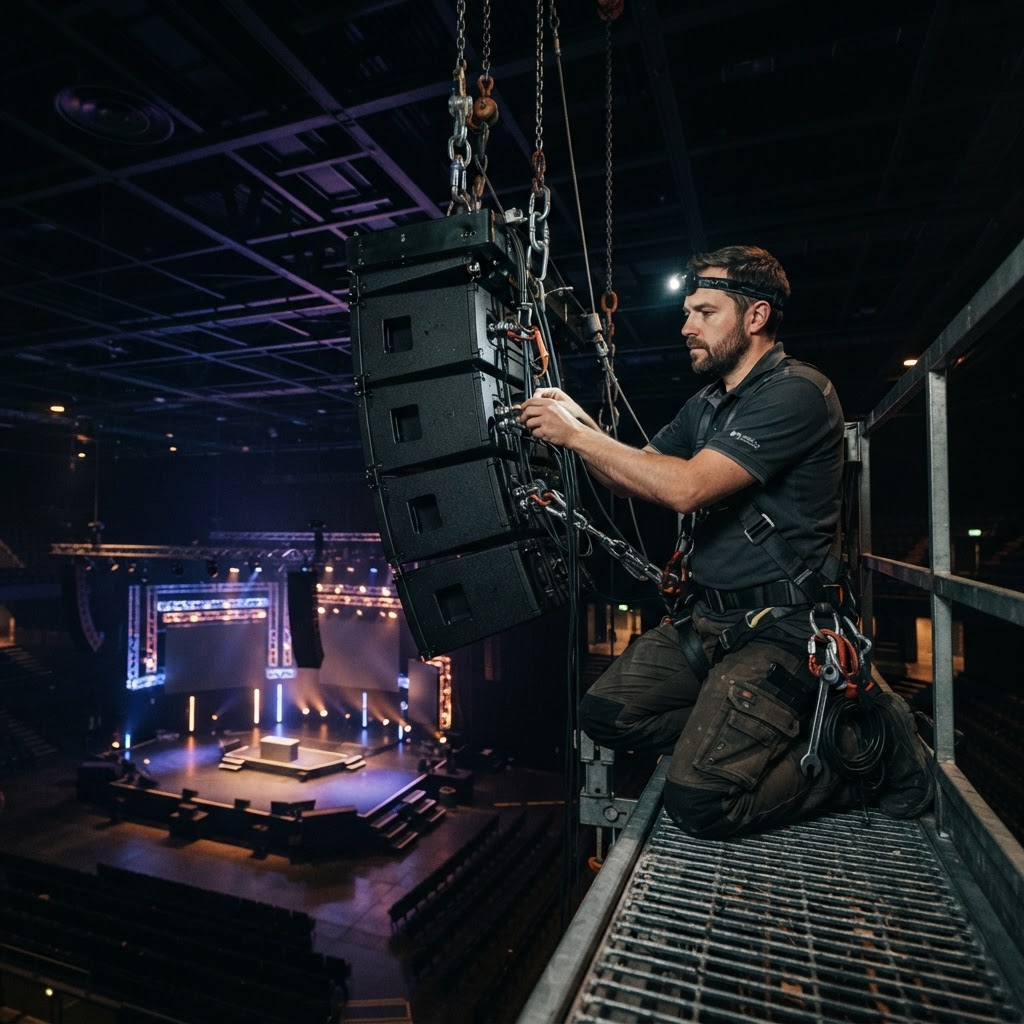
Line arrays solve a different problem: long throw with controlled vertical dispersion. By stacking multiple cabinets and controlling the splay angle between them, a line array lets sound couple together so it falls off more slowly over distance than a single point source cabinet would. That matters when you're covering 100+ feet of depth, when there's a balcony that needs separate coverage, or when you need to keep sound off a back wall that would otherwise cause nasty reflections. This is why concerts and live music productions default to line arrays — the rooms and outdoor sites are simply too large for point source to cover evenly without blasting the front rows to reach the back.
Ceiling height is the detail most planners miss. A line array needs vertical real estate to work — both to hang the array itself and to achieve the splay angles that make the coupling effect useful. In a ballroom with an 11-foot drop ceiling, a flown line array often can't be rigged high enough to do its job, and you end up with a system that costs more than point source but performs worse. In that scenario, ground-stacked point source on subs, or a modest line array ground-stacked at the sides of the stage, usually beats a flown array fighting a low ceiling.
Room width and seating shape matter as much as depth. A wide, shallow room — more seats side to side than front to back — is often served better by two or three point source hangs spread across the width than by a single center-hung line array trying to cover everyone with vertical splay alone. Line arrays excel at depth; they don't automatically solve width. Fashion shows and runway events, for example, frequently need distributed point source or compact line arrays positioned along the runway rather than a single large array at one end, since the audience sits along both sides rather than facing one direction — a layout worth mapping out early with your fashion and runway production team.
Budget conversations get easier once the room dictates the system instead of the other way around. Line array hardware costs more, needs more rigging points, more cable, and more calculation time to set splay angles correctly — all of which shows up in the quote. If a planner is pricing audio production for a 150-person breakout room and gets quoted a line array, that's worth questioning. Conversely, if a 2,000-person general session is quoted two point source tops on sticks, that system will not reach the back of the room evenly, and intelligibility will suffer no matter how good the mix is.
Outdoor events add another variable: there's no ceiling to catch reflections, but there's also no wall to stop sound from traveling past your audience into a neighborhood or adjacent activation. Line arrays give engineers tighter vertical control to aim sound at the crowd and away from everything behind them, which matters for brand activations running near other booths or residential areas with noise ordinances. Point source rigs, by contrast, throw sound in a wider cone that's harder to contain, which is fine in an open field but a problem in a dense outdoor plaza.
Hybrid setups are common and often the smart answer. A center cluster of point source for near-field coverage paired with delay speakers further back, or a small-format line array flanked by point source fills for the front few rows, solves coverage gaps that a single system type can't handle alone. This is standard practice for long, narrow spaces like hotel function rooms split by airwalls or trade show halls with low ceilings but deep floor plans — common territory for corporate events where the room was built for flexibility, not acoustics.
Before locking in a system type, run the room dimensions, ceiling height, and expected audience count through a coverage estimate rather than guessing from a photo of someone else's event — the event sound calculator gives a starting point for matching system size to room size before a vendor walks the space. And if the gear is coming from a rental house rather than a full production partner, confirm the inventory actually includes properly matched line array elements and rigging hardware, not just whatever boxes are in stock — equipment rental listings should specify cabinet type and quantity so you're not finding out on load-in day that the room and the system don't match.